Everday is a new adventure. After a hectic early morning escapade, it was nice to relax a little bit on the way to the island. It the day was a little gloomy from overcast, but was still relatively warm (probably about 75 degrees) with some light winds throughout the day. Once we arrived on the island I could see a rock filled beach with little sand, which we learned was called a cobble stone beach. This is one of the four types of beaches in the New England region, the others being: rocky, sandy, and mud-flats. From here we walked across to the other side of the island, where we could noticeably see the, I think its called, "wrackline" which consists of all kinds of debris and sea weed. We could also see the line that separated the dry part of the beach from the wet part showing the tide was regressing to low tide. The average of high tide in this area is around 9 feet but can reach up to 12 feet in the summer. It was here that we got to learn about the "Brazil Nut Phenomena" which states that bigger solids come to the top. A variety of things can affect these rocks(both its position and its form) such as: currents, human activity, tides, and storms. On the beach we could see it was littered with blue mussel shells and, as we looked closer in the wet area, could see it was full of periwinkles which were our main focus for the day. We all picked them up and observed them. We tried just about anything to get them out of there shells from rocking them to singing them lullabies. These periwinkles were diverse in that some had strips and some didn't and they varied in color. These animals are harmless to humans, however they are enemy to anyone who likes sandy beaches, because they help turn them into rocky beaches. As we got to look at these snails close up we could see that some of them had little holes in their shells. I think that there could be more than one predator resposnible for this: the Dog Whelk, Oyster Drill, and the, I think, dog snail along with other various kinds of rock whelks. All of which use their teeth like tongues to penetrate the periwinkles very strong shells in order to eat and I think any of these animals could be responsible.
We then walked for a few minutes down the shore to eat lunch. Mr. Berman found some interesting snail shells that were not periwinkles. I think they might be known as a brown-lined snail or something like that. I learned that these shells(the dead ones we found) could be determined older or younger than others. The shell of the older one would be more eroded from weather, scowered, and more faded than the younger ones. Later, we saw similar snails on our hike through a trail. The snail that I found was high on a branch behind on a sumac, I think they are called. I also noticed that one of the teams around me were finding their snails in branches as well. So, clearly they are mor comfortable in a tree than on the ground. This led to the question, how did they end up on beach? It was suspected by some students and hinted stongly by Mr. Berman that they could have ended up there because of the birds. I can totally see that because maybe, just like some of the gulls by the tide pool pick up crabs and drop them and then eat them, maybe they do something similar to the snails. Prior to this part of the trip we took a walk through a marsh, which no longer stays wet consistently due to government interference. We got to see a plant called pepper weed that had a distinguished smell to it. Once through the marsh we came to the tide pool. It was the not best smelling part of the island, but it was filled with all kinds of wildlife. There were several bird in the nearby distance like gulls, sand pipers and oyster catchers. The shallow part of the pool was filled with periwinkles, hermit crabs, green crabs ( main predators of the periwinkles), and some very small shrimp that I am unable to identify. I know the rangers told what they were but I forgot. I assume that many of these animals are not native but maybe hitched a ride by boat, storm, or maybe oven another animal it was latched onto. It was cool to see, when up close, how many of these animals lived so close to each other in this part of the pool. I was not one of the more adventurous who went out to the deeper end of the pool, but thanks to several students, was able to see a lobster from a distance, which was cool.
We concluded the trip by taking the shells and separating them into groups, some larger than others. This must be due to "Natural Selection" that Mr. Berman talked about earlier in class. Maybe the smaller groups were better suited for the island than the other larger ones(because less perished). Or maybe looking at the other way around, there are less snails(the smaller groups) so there must not be very many of them. The main difference I saw between the Barking Crab trip and this one was that there was much more life in this area. Probably due to the fact that we were in a much more wild-like habitat and there was much more growth in both on land and in the water.
-Ryan Santana
Monday, August 3, 2009


Lovell's Island, Day 2
Yesterday morning we took boat to Lovell's Island where we spent the entire day. We learned that Lovell's Island is cobble beach (both rock and sand) and that there was a 9 foot tide that was going out about 1 1/2 feet per hour. The larger rocks were on top of the smaller rocks and sand, and Bruce informd us that this was because of the Brazil nut phenomenom where the larger things come to the top and the smaller stuff (sand) goes under the rocks. We also learned that there are 3 types of island catergories, 1. used (George's) 2. less used (Lovell's) and 3. outer, which are largely untouched.
When we arrived at Lovell's Islnd we mde our way to the shore where we found periwinkles, which are very common. While these periwinkles are very common and the average person believes they are native they are actually invasive originating from Canada. The theory of how the came to our shores is that they gradually traveled down the coastline and turned sandy beaches into rocky beaches over 200 years, and they are the Most destructive invasive species. We were able to find some live periwinkles (picture below), but we also found many dead ones. A number of these empty periwinkle sheels had a small hole drilled in it, leeting us know that it had been attacked by a predator. Bruce mentioned that one of it's predators was the satr fish but asked to find out what else could have drilled the hole in the shells. Upon some reseach online I found that it was most likely the green crab (www.cobscook.org)
We then walked down the shore a bit and stop to have lunch, where Bruce found an unusual type of land snail that he asked to identify. We later found these snails on a trailt that we were walking along trying to find some ripe blackberries. After some looking I believe that these snails are Cepaea nemoralis (grove snail or brown lipped snail) and their dfferent coloring is due to the fact that they are polymorphic. The color of the snail can vary from yellow to pink to a brownish, and it can be as a darker more noticable color or pale and sometimes almost white. They can be found with and without bands and the bands vary in color and size. One reason of thinking for the variations n coloring for protection from predators, such as birds which could be one way that the empty shells found their way to the beach that or Bruce planted them there.


After lunch we walked through the marsh to the other side of the island, where we were able find some crabs. I;ve been having a hard time trying to identify the type of crab that we were found. But I have few thoughts to what it type it could be. Initally I thought maybe Carcinus maenas (green crab) but from the guidebooks description the ones we found maybe too small. My other possibility was the Planes minutus (Gulfweed crab) which would be about the right size and is peckled but it's not very clear to me where they are typically found.


Redo of Saturday's assignment
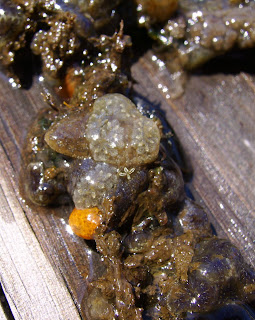
I looked at my photos of the tunicates and the guide book again and I still think that what I found was a Golden Star Tunicate (Botrylus schlosseri) which according to the books description is found in Boston, is 3-4 inches in size, are often golds, purples and browns, are often abundant in summer along the coast, and adhere to to seaweed, eelgrass, and other firm substratum. And a Sea Pork (Amaroucium stellatum) which can have 6-20 bright red or orange zooids, is found from Cape Cod to the Gulf of Mexico.

When we arrived at Lovell's Islnd we mde our way to the shore where we found periwinkles, which are very common. While these periwinkles are very common and the average person believes they are native they are actually invasive originating from Canada. The theory of how the came to our shores is that they gradually traveled down the coastline and turned sandy beaches into rocky beaches over 200 years, and they are the Most destructive invasive species. We were able to find some live periwinkles (picture below), but we also found many dead ones. A number of these empty periwinkle sheels had a small hole drilled in it, leeting us know that it had been attacked by a predator. Bruce mentioned that one of it's predators was the satr fish but asked to find out what else could have drilled the hole in the shells. Upon some reseach online I found that it was most likely the green crab (www.cobscook.org)

We then walked down the shore a bit and stop to have lunch, where Bruce found an unusual type of land snail that he asked to identify. We later found these snails on a trailt that we were walking along trying to find some ripe blackberries. After some looking I believe that these snails are Cepaea nemoralis (grove snail or brown lipped snail) and their dfferent coloring is due to the fact that they are polymorphic. The color of the snail can vary from yellow to pink to a brownish, and it can be as a darker more noticable color or pale and sometimes almost white. They can be found with and without bands and the bands vary in color and size. One reason of thinking for the variations n coloring for protection from predators, such as birds which could be one way that the empty shells found their way to the beach that or Bruce planted them there.


After lunch we walked through the marsh to the other side of the island, where we were able find some crabs. I;ve been having a hard time trying to identify the type of crab that we were found. But I have few thoughts to what it type it could be. Initally I thought maybe Carcinus maenas (green crab) but from the guidebooks description the ones we found maybe too small. My other possibility was the Planes minutus (Gulfweed crab) which would be about the right size and is peckled but it's not very clear to me where they are typically found.


Redo of Saturday's assignment
I looked at my photos of the tunicates and the guide book again and I still think that what I found was a Golden Star Tunicate (Botrylus schlosseri) which according to the books description is found in Boston, is 3-4 inches in size, are often golds, purples and browns, are often abundant in summer along the coast, and adhere to to seaweed, eelgrass, and other firm substratum. And a Sea Pork (Amaroucium stellatum) which can have 6-20 bright red or orange zooids, is found from Cape Cod to the Gulf of Mexico.


Hi Guys!
I had a blast yesterday, my advisor wasn't kidding when she told me how interesting and how much fun this class was suppose to be, according to students that took this class in past.
The weather started out sunnier and later in the day the clouds got a little heavier. During the ride in the first boat professor Bernan explained something which I never paid much attention to, natural selection. How new species are introduced to the Eco-system and how others succumb.
When we arrived at the Lovells Island we had a chance to hear a small introduction about the island by one of the park rangers. Looking at the map on the sign by the entrance I notice a small spot on the northern part of the island where we would end up walking by and learning about invasive plants as well and its impact on the salt marsh.
Our first stop was at Cobble Beach where we learn about the "Brazil nut phenomenon" where small particles like sand end up at the bottom and larger objects end up on top. Cobble Beach was a perfect example of that, we saw not much larger rocks at higher ground. We also talked about the effect of people, erosion and the periwinkles on the shape and size of islands.
Our first organism to be analyzed was the periwinkles, an introduced specie brought from Europe more than 100 years ago. We found many dead ones as well as some live ones. Professor Bernan mentioned that periwinkles can destroy or modify the size of sand area on beaches. We also learned about how they survive. Other than food moisture is very important for them. They have are covered with a protective operculum works as natural door that keeps the periwinkle from becoming dry, for instance low tides.
After having lunch with the "lunch less" members of the hockey team...we walked by the salt marsh. I apologize for not recalling the lady's name, we learned about the invasive species of plants, Fragmite weed, pepper weed-smells like horse hadish- which can adapt very well to salted water.
Arriving at the other side we were able to analyze the abundant life withing the tidal pool. We found more periwinkles as well as tunicates on the rocks and the invasive Asian shore crabs.
After leaving the tidal pool we went to a part of the island where they were many land snails, white-lipped snails and grove snails. Professor Benan asked us if the we anyone thought that these snails have anything to do with the periwinkles and some us said yes, they could be decedents of the periwinkles but further research would be necessary to affirm it. These land snails are very popular in Europe and are found in grassland areas and also wood areas. I understood that they love humidity.
Question#1
What caused the holes on the periwinkles?
After some reading on the web I keep getting mixed information. Some sites did mentioned that blue crab as a predator but what it sounded more convincing to me was the moon snail. The moon snail is one of the top predators of the intertidal environment.
Question#2
Where did the snails we saw at the beach come from?
The oyster-catcher is to blame. They use their bill to firmly hold the shell of the land-snail and with a lot of pressure it crushes the shell feeding on the snail. So I think as the during this process the bird could be flying therefore dropping the empty shell on other parts of the island.
Question#3
What kind of crab were those at the tidal pool?
According to the the MIT website, they are an invasive species native from the western Pacific ocean was introduced to the southern New England shores more than a century ago.
Question#4
What are the differences between the live and dead snail shells?
I thing the difference is mainly the exposure to the weather and where it occurred.
Re-do of the Barking Crab Journal
After reading the students' assignment#1 including my own I found out that what I though was sponges were indeed the invasive tunicate. In regards to my own comments about the Red-eye Amphipod, they could vary in size depending on the growth stage.
See you later,
Mike
Lovells Island
Hey Everyone!
Today was a very interesting day out on Lovells Island. The weather was slightly overcast and the areas where we observed today had a lot less human traffic than the area around the Barking Crab from yesterday. We started out with a boat ride over to the Island during which Bruce explained how new species are introduced to the ecosystem. He explained that the new species must adapt, otherwise over time they will become extinct due to natural selection. We learned that that only thing that differentiates exotic species from invasive species is our opinion about the species and how it interacts with the native ecosystem. Once we arrived at Lovells Island, we were given a quick overview of the island by park ranger Chris. He attempted to show us that the island looks like the shape of a ram, but it requires some imagination to actually see it. First stop on the island was the cobble beach, a beach which has both rock and sand. We learned about the “Brazil Nut Phenomenon” as an explanation of why when you have a group of solids, the larger object would be on top (i.e. rocks and a sandy beach).
Next we proceeded to collect some shells mainly blue mussels, common periwinkles (Littorina Littorea), and shells that I have identified to be cockles. We went into some discussion over what the periwinkles predators are and I have come to the conclusion that other than starfish the green crab is a predator of the periwinkle which causes the wholes in the periwinkles shell (www.cobscook.org). Next after Bruce bet us we couldn’t find a snail shell other than a periwinkle I found one (but apparently the time frame of the bet had expired… sure sure). I think it may be an Oval Marsh Snail based on my research, but I will attach the picture I took so you can check it out yourselves (sorry my picture is poor quality, I took it with my phone). The Atlantic Seashore Guide describes Oval Marsh Snails as “columella (central column) distinctly toothed. To ¼ in.”.

Next, during out lunch break Bruce showed us some terrestrial snails. I belive these snails are a mixture of white-lipped snail (Cepaea hortensis) and the grove snail (C. nemoralis), which are very similar snail species (http://www.answers.com/topic/white-lipped-snail-1). I believe these terrestrial snail shells can be seen on the beach due to either a predatory bird that may have eaten the snail and dropped the shell on the beach, or small children and college science Professors playing with them and moving them. Later on we spotted many more in the sumac trees in the center of the island.
Next we went and looked for crabs and other sea creatures in the tide pools, though it was still somewhat high tide so our sightings were limited. Most of us found crabs underneath rocks, the one I found was smaller which leads me to believe it was a juvenile green crab (carcinus maenas) since the crabs seen today meet the description in the Atlantic Seashore Guide of color, location, size and habitat. Later in the tide pool we spotted a lobster, a sea squirt, and long-clawed hermit crab.

As for the final question regarding the differing variations of snail shells found, I believe over time the snails have adapted to different environments causing their shells to change colors to protect themselves. The snail shells with living snails inside appear to be darker than the shells alone which I believe could be due to bleaching in the sun while the living ones are hiding in shady trees.
Today was a very interesting day out on Lovells Island. The weather was slightly overcast and the areas where we observed today had a lot less human traffic than the area around the Barking Crab from yesterday. We started out with a boat ride over to the Island during which Bruce explained how new species are introduced to the ecosystem. He explained that the new species must adapt, otherwise over time they will become extinct due to natural selection. We learned that that only thing that differentiates exotic species from invasive species is our opinion about the species and how it interacts with the native ecosystem. Once we arrived at Lovells Island, we were given a quick overview of the island by park ranger Chris. He attempted to show us that the island looks like the shape of a ram, but it requires some imagination to actually see it. First stop on the island was the cobble beach, a beach which has both rock and sand. We learned about the “Brazil Nut Phenomenon” as an explanation of why when you have a group of solids, the larger object would be on top (i.e. rocks and a sandy beach).
Next we proceeded to collect some shells mainly blue mussels, common periwinkles (Littorina Littorea), and shells that I have identified to be cockles. We went into some discussion over what the periwinkles predators are and I have come to the conclusion that other than starfish the green crab is a predator of the periwinkle which causes the wholes in the periwinkles shell (www.cobscook.org). Next after Bruce bet us we couldn’t find a snail shell other than a periwinkle I found one (but apparently the time frame of the bet had expired… sure sure). I think it may be an Oval Marsh Snail based on my research, but I will attach the picture I took so you can check it out yourselves (sorry my picture is poor quality, I took it with my phone). The Atlantic Seashore Guide describes Oval Marsh Snails as “columella (central column) distinctly toothed. To ¼ in.”.

Next, during out lunch break Bruce showed us some terrestrial snails. I belive these snails are a mixture of white-lipped snail (Cepaea hortensis) and the grove snail (C. nemoralis), which are very similar snail species (http://www.answers.com/topic/white-lipped-snail-1). I believe these terrestrial snail shells can be seen on the beach due to either a predatory bird that may have eaten the snail and dropped the shell on the beach, or small children and college science Professors playing with them and moving them. Later on we spotted many more in the sumac trees in the center of the island.

Next we went and looked for crabs and other sea creatures in the tide pools, though it was still somewhat high tide so our sightings were limited. Most of us found crabs underneath rocks, the one I found was smaller which leads me to believe it was a juvenile green crab (carcinus maenas) since the crabs seen today meet the description in the Atlantic Seashore Guide of color, location, size and habitat. Later in the tide pool we spotted a lobster, a sea squirt, and long-clawed hermit crab.

As for the final question regarding the differing variations of snail shells found, I believe over time the snails have adapted to different environments causing their shells to change colors to protect themselves. The snail shells with living snails inside appear to be darker than the shells alone which I believe could be due to bleaching in the sun while the living ones are hiding in shady trees.
Sunday, August 2, 2009
Assignment #3 (Lovells Island)
Today we started out on the nude beach of Lovells Island around 10:30 AM. Th beach was quite rocky and filled with shells from snails, muscles, clams, ect... We were asked to find periwinkles along the shore both alive ones and abandoned shells. After observing the shells for awhile a question arose about the drill hole in he side of some of the shells. Upon searching google for the answer to which organism creates these holes many fingers point in the direction of the Moon Snail.
As we walked along the beach we decided to stop and have lunch until Bruce interupted us with his finding of a bunch of snail shells unlike the ones we saw earlier. He asked the question "Where do you think these came from". Later on in our exploration we found the same kind of snail shells and living snails along the paths of the inner Island. After doing research I have identified these snails as garden snails. They could also be grove snails which would make on wonder why they are in Boston when they are most common in Europe.
After doing much research about the crabs I was unable to come up with an answer of what kind of crab they actually were. If anything I would have to guess that it was just your standard mud crab or the Liocarcinus vernalis. I do know that they live under rocks and they are quite small which are pretty consistent characteristics of these types of crabs.
Yesterdays blog
After reading over every ones thoughts about yesterdays dock experience and spending more time studying organisms today on Lovells Island I was able to come up with an observation. The Tunicates we found yesterday were no where to be found today on Lovells Island. I feel like there is a relationship between the types of material they grown off of. Lovells had very limited dock area so they may have a tendency to attach to them.
As we walked along the beach we decided to stop and have lunch until Bruce interupted us with his finding of a bunch of snail shells unlike the ones we saw earlier. He asked the question "Where do you think these came from". Later on in our exploration we found the same kind of snail shells and living snails along the paths of the inner Island. After doing research I have identified these snails as garden snails. They could also be grove snails which would make on wonder why they are in Boston when they are most common in Europe.
After doing much research about the crabs I was unable to come up with an answer of what kind of crab they actually were. If anything I would have to guess that it was just your standard mud crab or the Liocarcinus vernalis. I do know that they live under rocks and they are quite small which are pretty consistent characteristics of these types of crabs.
Yesterdays blog
After reading over every ones thoughts about yesterdays dock experience and spending more time studying organisms today on Lovells Island I was able to come up with an observation. The Tunicates we found yesterday were no where to be found today on Lovells Island. I feel like there is a relationship between the types of material they grown off of. Lovells had very limited dock area so they may have a tendency to attach to them.
Questions
I am not so hot with the identifying portion, but I am going to give it a whirl.
1.I think that the snails we saw today were Grove Snails. I found this by going to google image and typing in "snails on Boston Harbor" which then brought me to an image which brought me to Save the Harbor's Youth Blog where I found a picture of what looked like the snails we found today.
2.I did not get a good look at the crabs today, but rather the lobsters that we found under the rocks. I looked through the field guide but could not find anything that resembled what could have been the crabs we saw today. So, on this one, I fail. I could just copy someone else's answers, but that would be wrong.
3. After googling a few different times to figure out what makes holes in snails, I kept coming across something called a "Moon Snail". But, wouldn't we have had to see the moon snail as well as the other snails on the island today? Yes, but I did not see any. I looked up the moon snail and found that while it is found world wide, it is mostly in the Arctic and Antarctic waters. This was starting to really bug me so I searched further and found that the Northern Moon Snail is found in Atlantic waters. So, the Northern Moon Snail might be our culprit. Not likely since we did not see their shells today, but this is my guess.
4. I think that old shells may stay in one spot for a long time and are therefore subject to long periods of intense bleaching sun. Or, they may be in the water for a long time rubbing against the sand wearing them down. The live shells move around and may seek shelter from these damaging forces.
1.I think that the snails we saw today were Grove Snails. I found this by going to google image and typing in "snails on Boston Harbor" which then brought me to an image which brought me to Save the Harbor's Youth Blog where I found a picture of what looked like the snails we found today.
2.I did not get a good look at the crabs today, but rather the lobsters that we found under the rocks. I looked through the field guide but could not find anything that resembled what could have been the crabs we saw today. So, on this one, I fail. I could just copy someone else's answers, but that would be wrong.
3. After googling a few different times to figure out what makes holes in snails, I kept coming across something called a "Moon Snail". But, wouldn't we have had to see the moon snail as well as the other snails on the island today? Yes, but I did not see any. I looked up the moon snail and found that while it is found world wide, it is mostly in the Arctic and Antarctic waters. This was starting to really bug me so I searched further and found that the Northern Moon Snail is found in Atlantic waters. So, the Northern Moon Snail might be our culprit. Not likely since we did not see their shells today, but this is my guess.
4. I think that old shells may stay in one spot for a long time and are therefore subject to long periods of intense bleaching sun. Or, they may be in the water for a long time rubbing against the sand wearing them down. The live shells move around and may seek shelter from these damaging forces.
Re-evaluation of Yesterday's Notes/Random Notes
After further investigation, it might be possible that I did not actually see a Mottled Tube Maker, but I am pretty positive that what was saw was an amphipod.
Also, I forgot to mention that Larissa and I saw a sea squirt today while we were flipping rocks in the tide pool.
Also, I forgot to mention that Larissa and I saw a sea squirt today while we were flipping rocks in the tide pool.
Lovell's Island (Nude Beach) Today's Notes
02 August 2009
Daytime
Rocky beach area observations:
Daytime
Rocky beach area observations:
- Lots of rocks, washed up lobster traps, rocks put there by the government for erosion control
- Brazil nut phenomenon - sand settles first, big rocks after
- High tide line- animals live below the tide line, it goes out 1 1/2 ft per hr
- Wrackline- did not get notes on this, need to investigate further
- Shells-Periwinkles, blue mussel
- Some snails are not native but invasive
- Snails were introduced in Nova Scotia
- Snails eat vegetables, algae, and sometimes animals
- Algae holds sand on the beach
- Turns sandy beaches into rocky shorelines over a period of 200 years
- Very destructive for sandy beaches
- Snails natural predators are starfish
- Snails have no gills, no lungs (pulmonate)?
- Snail poop- frass
- Snails need calcium
- No longer exists
- Being taken over by fragmytes, pepperweed (invasive)
- Bittersweet, pepperweed,
- Gulls, Oyster catchers, sand pipers, Slotted sand pipers
- Picked up rocks and found crabs and lobsters


Assignment 3

Aug. 2, 2009
Journal Section:
Lovell's Island, MA, 75 degrees, partly cloudy
Stop #1 10:30 AM
Our first stop today was at a cobble beach on the island. The tide had begun to go out. We collected various shells scattered throughout the beach including Blue Mussel shells as well as shells from Common Periwinkles.
Stop #2 approximately 11:30 AM
Next we moved on to what used to be a salt marsh but is now dried up do to the new man-made sea wall. Here we observed Pepper Weed which is an invasive plant species taking over the salt marsh. The root smells like horseradish.
Stop #3 approximately 12:00 PM
We then walked to the Tide Pool. Canadian Geese, a Spotted Sandpiper, Sea gulls, an a Herring Gull were all hanging out around the little bit of moist salt marsh left near the tide pool. We also
 observed and caught Asian Shore Crabs who were hanging out in the tide pool underneath rocks. As the MIT Sea Grant website states, "Originally introduced from Asia, it now ranges from Maine to North Carolina, preferring rocky cobble floors in the intertidal and subtidal zones."
Stop #4 approximately 12:45 PM
The class then followed a path through the more forested area of Lovell's Island. Here we searched for land snails which I believe can be identified as either Grove (Brown-Lipped) snails or White-Lipped Snails.
 Stop #5 1:30 PM
We then returned to the tide pool where one of our fellow classmates found an American Lobster.
Q&A Section
1. What made holes in the periwinkle's shells?
We discussed how Starfish are natural predators of the Periwinkles, but I believe the organism that preys on the Perwinkle by drilling a small hole in the shell's side is a Moon Snail. Moon snails are known to prey on smaller snails and drill holes into the victim's side.
2. What were the unusual snails and how did they get onto the beach?
I believe these so called "unusual" snails we found on the beach were actually just land snails possibly Grove or White-Lipped snails. I believe they could have gotten onto the beach, other than Bruce putting them there, by some type of predatory bird.
3. What kind of crabs did we find in the tide pool?
We found Asian Shore Crabs which are an invasive species from Asia. As the MIT Sea Grant website states, "Originally introduced from Asia, it now ranges from Maine to North Carolina, preferring rocky cobble floors in the intertidal and subtidal zones.
4. Why the difference between the live and dead snail shells?
The snail shells that we collected which have been dead longer had much more bleached out eroded shells than their live counterparts. What was once bright yellow is now pale yellow after laying on the ground or beach dead under the sun. The shells of the live snails have brighter colors due to more nutrients than the dead snail shells and more moisture.
Re-Do of Barking Crab Journal
I believe I was mistaken when I said we found Red Beard Sponge on the docks. I now know that it is indeed Tunicate. Possibly Orange Sheath Tunicate as well as Star Tunicate.


assignment 2
Hey everybody today was our first day outside of the classroom. We started off the day on a great boat trip and got a real great visual of the boston inner harbor and some of the islands that were on our maps. After Lunch is where things really got good. We were able to walk along the pier and look at some very interesting things. We really started to buckle down when we got to Barking Crab. I worked with Han and Renee. We started view the surrounding habitat in a shaded region of the dock. her were able to discover some sea lettuce cover in what looked like t be crude, some muscles, and we got to see some baby true crabs walking around. This crabs were smaller than a persons fingernail. When we moved to the sunny region of the dock things really got interesting. Were able to see that the sea lettuce was actually covered in what appeared to be different forms of sponge. I think i was able to determine that I saw some fig sponge, red beard sponge, golden star tunicate varient, and orange sponge. These fixtures were all attached to the sea lettuce and really came out in the sunlight under the water. They all felt like some type of smooth leather. You can see some of our great observations form Hans photos in his blog.
In regards to the difference of last year i feel that the amount of rainfall has help the cause. With the water having more salinity and less sunlight there has been less time form things to grow. Last year these things were able to grow at a quicker rate in the water.
Assignment #2: Observing Boston Harbor
Hi Everyone! Today was a very informative day and I must say I have already learned quite a bit just on Day 1. In all my years of living in Massachusetts, I must have visited or passed certain areas of the Boston Harbor hundreds of times but not until now do I really appreciate the history, composition and evolution of the harbor.
During our stops at the three main destinations we visited: Rowes Wharf, The Four Points Channel and the Bark & Crab, I made the following key observations: Date: 8/1/09, Time: between 1pm and 4pm, Tide: low, Air Temperature: approximately 83 degrees, Water Temperature: approximately 65 degrees, location: areas of the Boston Harbor, brackish water in the area of The Four Points Channel. At all three locations I observed an encrusted orange substance which after further research, my team (Monique and Ryan) and I were able to determine it to be Golden Star Tunicate. Specifically at the Barking Crab location we encountered a large installation of muscles of various sizes. We also examined an interesting slimy substance, including a section with a surface similar to that of tiger print as well as a minute star fish colony. We determined this to be Black Speckled Bryozoan. Furthermore we noted a leafy lettuce like substance which in fact is called ‘Sea Lettuce’. An interesting common observation which was also made is that all these organisms seemed to only grow or accumulate on the plastic surfaces below the docks and not on wood or metal. Furthermore it appears that we encountered an evasive species in the ‘cheeto’ like barnacles which may have been Northern Rock Barnacles
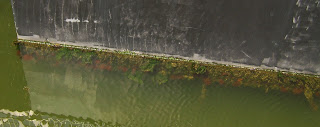
As to the photo of the dock last year and how it has changed this year, it appears from last year’s photos that there was a wide array of additional organisms which we simply did not see today. This is most likely due to the factors which we have been faced with this year such as the following: high levels of rain, diminished sunshine, decreased salinity, decreased turbidity and bacteria.
Lastly, here’s a photo of our class mascot (the starfish)!


- Nick Pinheiro
Assignment 2


August 1, 2009, Boston Harbor, 80 degrees, Day time
On our trip around the harbor today we made multiple stops in order to check out the sea life growing right beneath the docks we commonly walk on when strolling through the harbor:
Stop #1
Our first stop was at the dock directly behind the Longwharf Marriot Hotel. Along the rocks surrounding the dock, black and green Rockweed grew on top of the rocks in the tide and above tide. Shells of mussels were also scattered throughout the Rockweed
Stop #2
Only a few feet away from the Rockweed covered stones, there was a floating dock whose half that was under water continually, was covered in orange and green seaweed and kelp. The organisms growing here are always under water and were exposed to sunlight.
Stop #3
Next we stopped on floating private docks. Under the docks, growing on the plastic floaters were brown and green barnacles, orange sponge which could possibly be Red Beard Sponge. They were all in the shade at the time during low tide.
Stop#4
Our final stop for the day was at the docks adjacent to the Barking Crab restaurant. These docks were also floating. Nick, Ryan, and I observed an area in the shade underneath the larger, looming bridge. We found growing on the plastic floaters, what we thought to be Blue Mussels with barnacles growing on top of each. Within the barnacles on top of the Blue Mussels were tiny almost transparent worm-like organisms. We also found Red Beard Sponge. On the sunny side of the dock we found seaweed and more Red Beard Sponge encrusted with Black Speckled Bryozoan as well as Golden Starred Tunicate. We also spotted a pinkish starfish attached to one of the pillars supporting the dock.
Lastly, regarding the different species and amounts of growth from last year to this year's trip to the harbor docks, I believe the difference results from the uprise in rain we have received this summer as well as the cooler, less sunny weather. Also the currents are faster allowing less organisms to stay attached to the floating docks.
- Monique Bellefleur
moniqueb@bu.edu
Saturday, August 1, 2009
Day 1 (August 1st)
Hey,
Today was a great day. The weather was perfect, I got to see somethings that I haven't had the pleasure of seeing yet in Boston, and after getting over the initial 'eww' factor of sticking my hands in the water and pulling out whatever is down, I learned that it's not so bad and can be kind of fun and interesting.
While teamed up with Leana and Chloe at the Barking Crab, we examed a corner of the dock where we found seaweed and mussels on the plastic boxes. We pulled out some brushy red weed that had anthropods crawiling out from everywhich way. These anthropods looked kind of like super tiny shrimps and mites.
Next I found large piece of seaweed, which after lookng in my guidebook I beileve is dulse, a red seaweed. On this piece of seaweed were three different colonies. After examining this undewater, with the help of Bruce we were ble to remove them and look at them seperately. After consulting my guidebook I came to the conclusion that the clear and orange colonies are 'Sea Pork' which are 'hard rubbery lumps with zooids in circular systems'. And the other two colonies were variants of the 'Golden Star Tunicate' and these are 'soft, flat patches or lobes'.


In regards to the picture from last years class, there is a notable differnce from what we saw today. There is noticably more seaweed, mussels, sponges, etc. While comparing the photo from last year to one I took today I do't see much difference in the clarity of the water (but this could just be me). But all of the other factors that we discussed earlier today have definitely play a part in this. The excessive rain that we had in June and July, and in turn the lack of sun. Also the decreased salinity of the water and the lessened boat track that typically occures in the area.
Alexis Fagan
Today was a great day. The weather was perfect, I got to see somethings that I haven't had the pleasure of seeing yet in Boston, and after getting over the initial 'eww' factor of sticking my hands in the water and pulling out whatever is down, I learned that it's not so bad and can be kind of fun and interesting.
While teamed up with Leana and Chloe at the Barking Crab, we examed a corner of the dock where we found seaweed and mussels on the plastic boxes. We pulled out some brushy red weed that had anthropods crawiling out from everywhich way. These anthropods looked kind of like super tiny shrimps and mites.

Next I found large piece of seaweed, which after lookng in my guidebook I beileve is dulse, a red seaweed. On this piece of seaweed were three different colonies. After examining this undewater, with the help of Bruce we were ble to remove them and look at them seperately. After consulting my guidebook I came to the conclusion that the clear and orange colonies are 'Sea Pork' which are 'hard rubbery lumps with zooids in circular systems'. And the other two colonies were variants of the 'Golden Star Tunicate' and these are 'soft, flat patches or lobes'.


In regards to the picture from last years class, there is a notable differnce from what we saw today. There is noticably more seaweed, mussels, sponges, etc. While comparing the photo from last year to one I took today I do't see much difference in the clarity of the water (but this could just be me). But all of the other factors that we discussed earlier today have definitely play a part in this. The excessive rain that we had in June and July, and in turn the lack of sun. Also the decreased salinity of the water and the lessened boat track that typically occures in the area.
Alexis Fagan
Assignment 2
Hi, everyone.
It's a nice day today, and I have very happy time with you all. First, I want to express my gratitude to you for the help given to make me understand the details of the course and the main points which we are talking about. Thank you so much!
And It's the first time for me to post some observation and view by English, so I just read the assignments by Hilary and Sam that maybe effects me to use the similar form.
Today, we have a whole view of the Boston harbor which is really beautiful and exciting. And after lunch we begin our observation to find out what the hell that is. We visit 3 main areas including Aquarium port area, the Rowes Wharf dock, and the Barking Crab dock(quoted from Sam Gifford .To tell the truth, I only get the name of Barking Crab...I don't know how to describe the other two...)
A. Aquarium port area
There is tide here, and we find some organism(or maybe died). I take some photos (Press to see photos) and I find on the pictures that the seaweed have the opposite leaf on main axis which I think should be SOFT SOUR WEED ( Plate 4 of Altantic Seashore by Kenneth).
B.Rowes Wharf dock
There I also find something interesting because of their light colors (Press to see photos). And I think they should be SEA LETTUCE and GRINNELL'S PINK LEAF ( Plate 1&6 ).
C.Barking Crab dock
There we are going into groups , and I am with Sean and Rene. At first we are observing under the bridge . And take something from the dock which is really not so nice. But we find some organisms (Press to see photos ). It is really a small crab, maybe just half inch which I think should be a GULFWEED CRAB(Plate 58).And there are also some small shrimp(maybe something lik that) wiggling. I think it may be LUCIFER SHRIMP(Plate 52) cause it's small. Apart from that we find something maybe some kind of sponge. But its hardly to figure out it because it's on a shell , a messy coverd shell. Then we find some FRILLED ANEMONE(Plate 12), which is yound I think because of the small tentacles, and it's difficult to take it out from water with no destroy.
After that , we move to the sunshine area, where we find something surprise. And Prof. Berman take it out to watch easily. First is the STAR TUNICATE(Hitchhikers),which is really soft and smooth in surface (Press to see photos ). And there is also an orange things which just like roes I think. I think it may be GOLDEN STAR TUNICATE (Press to see photos). Then I find something under water which looks red. And I think it may be RED BEARD SPONGE(Plate 11)
(Press to see photos) And at last we see a sea star under the water on a wood.
And about why the organisms different from last year. I think may be caused by the rain and the temperature which lead the salinity change( I just heard that it's cool and rainy this year). In last year, there was higher temperature and less rain than this year which may cause the tunicate grows faster if the salinity is high. Maybe the low salinity also make there is less plankton, which used to feed the other organisms.
See you all tomorrow!
Han Han
It's a nice day today, and I have very happy time with you all. First, I want to express my gratitude to you for the help given to make me understand the details of the course and the main points which we are talking about. Thank you so much!
And It's the first time for me to post some observation and view by English, so I just read the assignments by Hilary and Sam that maybe effects me to use the similar form.
Today, we have a whole view of the Boston harbor which is really beautiful and exciting. And after lunch we begin our observation to find out what the hell that is. We visit 3 main areas including Aquarium port area, the Rowes Wharf dock, and the Barking Crab dock(quoted from Sam Gifford .To tell the truth, I only get the name of Barking Crab...I don't know how to describe the other two...)
A. Aquarium port area
There is tide here, and we find some organism(or maybe died). I take some photos (Press to see photos) and I find on the pictures that the seaweed have the opposite leaf on main axis which I think should be SOFT SOUR WEED ( Plate 4 of Altantic Seashore by Kenneth).
B.Rowes Wharf dock
There I also find something interesting because of their light colors (Press to see photos). And I think they should be SEA LETTUCE and GRINNELL'S PINK LEAF ( Plate 1&6 ).
C.Barking Crab dock
There we are going into groups , and I am with Sean and Rene. At first we are observing under the bridge . And take something from the dock which is really not so nice. But we find some organisms (Press to see photos ). It is really a small crab, maybe just half inch which I think should be a GULFWEED CRAB(Plate 58).And there are also some small shrimp(maybe something lik that) wiggling. I think it may be LUCIFER SHRIMP(Plate 52) cause it's small. Apart from that we find something maybe some kind of sponge. But its hardly to figure out it because it's on a shell , a messy coverd shell. Then we find some FRILLED ANEMONE(Plate 12), which is yound I think because of the small tentacles, and it's difficult to take it out from water with no destroy.
After that , we move to the sunshine area, where we find something surprise. And Prof. Berman take it out to watch easily. First is the STAR TUNICATE(Hitchhikers),which is really soft and smooth in surface (Press to see photos ). And there is also an orange things which just like roes I think. I think it may be GOLDEN STAR TUNICATE (Press to see photos). Then I find something under water which looks red. And I think it may be RED BEARD SPONGE(Plate 11)
(Press to see photos) And at last we see a sea star under the water on a wood.
And about why the organisms different from last year. I think may be caused by the rain and the temperature which lead the salinity change( I just heard that it's cool and rainy this year). In last year, there was higher temperature and less rain than this year which may cause the tunicate grows faster if the salinity is high. Maybe the low salinity also make there is less plankton, which used to feed the other organisms.
See you all tomorrow!
Han Han
cruising the harbor and scoping the wharfs
Today was an incredible experience. It was my first time for a lot of the things we did. The conditions could not have been any better. It was 80 degrees fahrenheit with a comfortable breeze. The day started at Starbucks, which was nice since I am a huge coffee fan. While there, we engaged in a crammed but very interesting history lesson. We learned from the time when the earth separated and how the glaciers carved the drumlins (boston harbor islands) to how the "Boston Harbor Clean-Up" was created all the way up until present day. After that, we went on a cruise around the harbor where we got to see many of the islands and learned both how these Islands were utilized and how they got their respective names. Many of them are named after an object it resembles or after the person who owns/owned it. All of this was done by noon, where we took a break for lunch and returned to resume class at 1. When we got back to Long Wharf we could immediatley tell the change in the tide which had sunk substantially. When we further observed the wharf we see the difference between the man-made part and the floating part of dock. The man-made area was closest to the sea wall. It contained some black and green seaweed(rockweed) and you could see oyster shell and mussells. It was very shallow. Fifty feet away from there, there was more color and less rockweed. This part of the dock was always wet. Therefore it is capable of hosting more, different kinds of marine life. There was some kelp, some orangey stuff and some green leafy sea lettuce. Just from this observation you can assume that there is much more wildlife outside of the harbor than there is closer to the city. From here, we "broke into" haha Rowes Wharf. While here we got to look under a floating dock that was shaded. Here I saw some barnacles, sponge, shells, and I was even able to see a fish through this dark and murky water. Our observation time got interrupted and were were forced to leave. Next we stopped at the Four-Point Channel, which I think used to be a fort. Gillette is the biggest company that utilizes this passage. Here we also learned about the different ways that they create bridges that are able to allow boats through. There are three different types: Counter Wake, Spin, and Rails (which work like a track that swings the bridge open). Storm water rushes through this area at high spees. Here, we also learned about the "Brackish" water which means it has more salinity than fresh water. To the "Barking Crab" we go. This was a very fun experience. We got to see things some peculiar things up-close. We saw some life forms that we had seen at the previous sites, but we also saw diffent kinds of life. Some sea weed that was grime-encrusted and a little distorted in view and we could see some stuff that kinda of looked like a star pattern which we(me, Monique and Nick) think to be called Golden Star Tunicate(sunny area). We also saw some stuff that looked like a kind of tiger or leopard print, which we think is called Black Speckled Byrozoan. We also noticed all of the different living animals on this plant. Under the dock was some kind of white spiky ball(dark area only) which I am not sure, but I hink might be called a Lined Anenome, which was right next to some shells which appeared to have some tentacles or something popping out. I could not find the name of this animal or plant. There were also some Red Beard Sponge and some Blue Mussels.
Coming from California, I know that when it rains that the level of bacteria increases, because of all the dirt and debris that it can push into the water. This can make it hazardous to someones health and increase their chances of getting sick. The plus side is that the ocean receives more nutrients. Salinity decreases because the water dilutes it, therfore making the water clearer(Trabidity). The current increases and I would think this makes it tougher for certain small animals and plants to stay put. So, that could mean less or different marine life in an area.
Last years picture looks much busier with more going on. I think I had to go with it being so rainy lately that, that is why there is less life on/under the dock. Plants/animals get pushed out, maybe they have to move to spot that is more saline? I am not sure. However, I am sure abbout one thing, the water sure looked cleaner.
-Ryan Santana
My partners were: monique and nick
Coming from California, I know that when it rains that the level of bacteria increases, because of all the dirt and debris that it can push into the water. This can make it hazardous to someones health and increase their chances of getting sick. The plus side is that the ocean receives more nutrients. Salinity decreases because the water dilutes it, therfore making the water clearer(Trabidity). The current increases and I would think this makes it tougher for certain small animals and plants to stay put. So, that could mean less or different marine life in an area.
Last years picture looks much busier with more going on. I think I had to go with it being so rainy lately that, that is why there is less life on/under the dock. Plants/animals get pushed out, maybe they have to move to spot that is more saline? I am not sure. However, I am sure abbout one thing, the water sure looked cleaner.
-Ryan Santana
My partners were: monique and nick
Assignment 2
For our first day of class today we had beautiful weather, about 80 degrees with clear skies and some wind. Our locations included Long Warf, Rowes Warf, and the Barking Crab and I was in a group with Hilary and Wade when we broke off into smaller groups. At the beginning of the day, we started out on the dock of the Boston Harbor where we saw a tidal pool, which included seaweed of a darkish brown color and with bubbles on the ends, which we later learned was called Phaeophyta. Then we proceeded to the dock and our visit was very unfortunately cut short and I have a feeling a certain someone will be losing their job come Tuesday at the BRA meeting. In Rowes Warf we were able to observe mussels, orange sponge-like things that I think are called Turnicate or loosanoffs haliclona, and sea lettuce.
Our third stop was the Barking Crab, aka Fan Pier, where we were able to break off into groups and get the opportunity to really scrutinize all the different organisms. After grabbing mussels out of the water, we discovered that there were many anthropods on them. We spent a good amount of time observing a shady part of the dock where we identified various types of tunicate (orange sheath, diplosoma, star, blue, and green), along with bowerbank's hilochondria. On the sunny portion of the dock we observed even more of a variety of organisms like starfish, pacific white crust, a giant feather duster, and barnacles. We paid particular attention to the fact that there was such a difference between the sunny side and the shady side; and we concluded that factors like sunlight and the current could have an effect on the organisms from last year causing them to differ.
In closing, in one class today I was able to learn a significant amount about the Boston Harbor that I had never known before that makes the Boston Harbor special. The hands-on approach to the class and the overall structure was extremely advantageous to learning. Looking forward to seeing you all tomorrow in class and singin' the song.
Joe Pereira, The Time Keeper
First day at the Boston harbor
I must admit that today, August 1, 2009 is some how an amazing day of the days i've spent in Boston. To begin with, the boat cruise was amazing because i didn't know much about islands and how those islands get their names. We begun our cruise at about 10:15 am and the water level at the dock was really high partly because it was early in the morning and the sun had just rose. We saw some islands like the spectacle island, moon island, long island and how they each earned their names. We returned at around 11:30am and we took an hour lunch break.
We returned back to work at 1:05pm by first noting that the water level at the dock had fallen. I however attributed the fall of the water level to the rise in the temperature from the sun. I think evaporation caused the water level to fall. We then continued to Fort Point landing and Barking Crab and we were confidently told that some areas are restricted and some areas are free for public use. To my surprise, I saw a warning, "These stairs are prvately owned, do not treaspass", so we didn't treaspass but continued on the Barking Crab.
At the Barking Crab, we were grouped into teams of two or three. In my team were Chris and Sam. We first started looking for living creatures underneath the docks in the shade. We found a pile of mussel and green leafy particles under the dock. Sam boldly grabbed the pile of mussels and put it on the dock. We then discovered that the mussels had tiny living creatures like shrimp living around it. We made a conclusion that the "tiny living" creatures were tiny shrimp or fish lice. The leafy particle was taken to be a sea weed.
We then moved to the sunny area to get more living creatures under the dock. We somehow found similar creatures like the mussel and the sea weed but the creatures in the sunny area looked more brighter and lively than those in the shade;the idea being that living creatures need water, air and sunlight to grow so those in the sunny area are basically gaining all the essential elements they needed to grow while those in the shade are lacking sunlight.
The diiference between the creatures from last summer and this summer is that last summer's creatures look more lively and brighter than this years. There has been more rain this summer than last summer which means that the level of salt content in the sea has reduced, so the creatures from this summer are finding really hard to grow since they are being deprived of sunlight.
We also got to know that some creatures are considered invassive creatures because they do not belong to the Boston area. Hopefully we will find alot of these invassive creatures in our next class tomorrow. See y'all
Samuel Appiah
We returned back to work at 1:05pm by first noting that the water level at the dock had fallen. I however attributed the fall of the water level to the rise in the temperature from the sun. I think evaporation caused the water level to fall. We then continued to Fort Point landing and Barking Crab and we were confidently told that some areas are restricted and some areas are free for public use. To my surprise, I saw a warning, "These stairs are prvately owned, do not treaspass", so we didn't treaspass but continued on the Barking Crab.
At the Barking Crab, we were grouped into teams of two or three. In my team were Chris and Sam. We first started looking for living creatures underneath the docks in the shade. We found a pile of mussel and green leafy particles under the dock. Sam boldly grabbed the pile of mussels and put it on the dock. We then discovered that the mussels had tiny living creatures like shrimp living around it. We made a conclusion that the "tiny living" creatures were tiny shrimp or fish lice. The leafy particle was taken to be a sea weed.
We then moved to the sunny area to get more living creatures under the dock. We somehow found similar creatures like the mussel and the sea weed but the creatures in the sunny area looked more brighter and lively than those in the shade;the idea being that living creatures need water, air and sunlight to grow so those in the sunny area are basically gaining all the essential elements they needed to grow while those in the shade are lacking sunlight.
The diiference between the creatures from last summer and this summer is that last summer's creatures look more lively and brighter than this years. There has been more rain this summer than last summer which means that the level of salt content in the sea has reduced, so the creatures from this summer are finding really hard to grow since they are being deprived of sunlight.
We also got to know that some creatures are considered invassive creatures because they do not belong to the Boston area. Hopefully we will find alot of these invassive creatures in our next class tomorrow. See y'all
Samuel Appiah
Picture
After looking at the picture, I think that there is a significant amount more life attached to the dock last year than this year. The only conclusion that I am confident enough to make at this point in my Snails to Whales career is that it is because we have been having serious amounts of rain. Today, we learned that the water is affected by rain in the following ways: salinity, nutrients, speed of current, and clarity of water (tribidity?). My thought is that the increased amount of rain causes a stronger current, therefore fragile things may not be able to hold onto the dock. Another theory is that maybe the rain water is acidic or polluted and therefore inhibits growth of certain life.
I am not able to access blackboard. I clicked the link to the alternate site but am having trouble downloading the hitchhikers information. Perhaps, someone may be kind enough to print me a copy or at least give me a general idea of what I am missing.
Thank you!
Alexandra Carry
I am not able to access blackboard. I clicked the link to the alternate site but am having trouble downloading the hitchhikers information. Perhaps, someone may be kind enough to print me a copy or at least give me a general idea of what I am missing.
Thank you!
Alexandra Carry
Islands tour and docks observation
Hello, my name is Rene Norris. Today was a great day weatherwise and we accomplished a lot on the observation front. The day began with a little history on the Laurentide Ice Sheet and the previous problems the Boston Harbor had with human waste contamination. We then hopped on to a boat that took us on a tour of the Boston Harbor. While we were leaving the dock and entering the open sea professor Berman explained why the difference in color of the harbor water and the ocean water. The harbor water is darker because of the rocks and vegetation in the bottom. The vegetation also stains the water causing an obscure effect. Meanwhile in the bottom of the ocean we find light minerals like sand and fine gravel. The breeze was nice and there was a delicious feeling when the boat would bounce on the waves. During our tour of the Boston Harbor we passed by all the Islands or at least by the most important ones.
After lunch we turned our attention to the tidal pool. The tide had dropped dramatically and the sea weed that danced so lively when the tide was higher seemed to had lost its life when the water receded.
We then moved to the floating dock where we managed to get a bit closer to all the submerged living creatures hanging from the man made structures. There were snails, algea, flower like animals, and even a star fish hanging from one of the poles. However, our stay was interupted by "security personnel".
On our way to our last observation site, we briefly stoped by the four point channel where we discussed the type of water that goes through the channel called "brakish water" (a combination of salt water and fresh water). We also touched on the types of bridges.
Finally, we arrived at the "Barking Crab". Here we broke up into groups, I worked with Han and Sean. We started by just grabing and picking a mixture of species. One of the things that cought my attention was that when we placed this spongy, hair like plant on the dock multiple creatures crawled out, even a crab. There were shells and clams living on the walls of the docks along with sticky, gouy like animals. I could not see eyes nor a mouth on them but I am convinced that even the specimens that were not moving had life because of their reaction to being out of their habitat; the water. When we moved to the side of the dock that is accessible to the sun, there were a few differences to the living creatures that were always or most of the times shadowed by man made structures. That is the presence of green sea weed and brown sea weed.
In regards to the picture from last summer of the conglomerate of species, the major differece I notice is that there seemed to be more species clamped up as to what we saw today. Secondly, although I saw a lot of colors today (orange, dark green, black, brown, etc), the colors in the picture of last summer seem more vibrant and the array of colors was deeper.
Rene Norris (rnorris@bu.edu)
After lunch we turned our attention to the tidal pool. The tide had dropped dramatically and the sea weed that danced so lively when the tide was higher seemed to had lost its life when the water receded.
We then moved to the floating dock where we managed to get a bit closer to all the submerged living creatures hanging from the man made structures. There were snails, algea, flower like animals, and even a star fish hanging from one of the poles. However, our stay was interupted by "security personnel".
On our way to our last observation site, we briefly stoped by the four point channel where we discussed the type of water that goes through the channel called "brakish water" (a combination of salt water and fresh water). We also touched on the types of bridges.
Finally, we arrived at the "Barking Crab". Here we broke up into groups, I worked with Han and Sean. We started by just grabing and picking a mixture of species. One of the things that cought my attention was that when we placed this spongy, hair like plant on the dock multiple creatures crawled out, even a crab. There were shells and clams living on the walls of the docks along with sticky, gouy like animals. I could not see eyes nor a mouth on them but I am convinced that even the specimens that were not moving had life because of their reaction to being out of their habitat; the water. When we moved to the side of the dock that is accessible to the sun, there were a few differences to the living creatures that were always or most of the times shadowed by man made structures. That is the presence of green sea weed and brown sea weed.
In regards to the picture from last summer of the conglomerate of species, the major differece I notice is that there seemed to be more species clamped up as to what we saw today. Secondly, although I saw a lot of colors today (orange, dark green, black, brown, etc), the colors in the picture of last summer seem more vibrant and the array of colors was deeper.
Rene Norris (rnorris@bu.edu)
1st day trip observations
SOURCE of identifications: Peterson Field Guide by Kenneth L. Gosner and http://massbay.mit.edu/exoticspecies/hitchhikers/hhgallery.html
Location: Long Warf
Time: 1:15 P.M.
Date:
Conditions: 80º F, clear
Observations: Sea lettuce, spongomorpha, red fern, lacy red weed, soft sour weed, and finger sponge.
Location: Rowes Warf
Time: 2:10 P.M.
Date:
Conditions: 80º F, clear
Observations: Horse mussels, banded weed, barrel weed, spongomorpha, sea potato, and dulse.
Location: Fan Pier
Time: 3:30 P.M.
Date:
Conditions: 80º F, clear
Observations: White crust, golden star tunicate, sea pork, boring sponge, and dead man’s fingers

Location: Fan Pier
Time: 3:40 P.M.
Date:
Conditions: 80º F, clear
Observations: Intrusive species of tunicate (Didemnum sp.).
In regards to the before and after comparisons to last year’s observations, “The combination of high water temperatures, low salinities, low irradiance levels, and high epiphyte abundances seems to have resulted in the low biomass and productivity” was a finding as a result of a study done in Florida from April 1995 to August 1996. Interestingly enough, I feel this study may help explain why there’s less growth in
http://www.jstor.org.ezproxy.bu.edu/stable/pdfplus/1353047.pdf
Finally, I’ve found that I was not able to access the Blackboard web site. I did however add a student request on the site so that I may hopefully have access to it on Monday (for anyone having the same issues).
See you all in the morning.
First Time at Boston Harbor
Hi Y'all!
Today was awesome. As of late, I have not been a fan of Boston and what you people here consider "summer" and the "water". You see, I grew up in South Florida (you know, where the REAL beaches are). But, today changed my mind. I am officially in love with the Boston Harbor. I got to the Long Wharf Hotel at 0630. For those who do not understand military time, that is 6:30am. Why you ask? Because I did not want to be late. Ya.... Directions + me =Not so much. Anywho, the day was beautiful. I loved the harbor tour. After (attempted) memorization of the Boston Harbor map, it was nice to actually see the islands that I had been staring at on a page for hours. Lunch was nice, but the best part of the day was the practical, hands on portion of the afternoon. I liked getting down on the dock and sticking my hands into the water. Sure, things felt slimy and sharp, but I really enjoyed it. I took a few notes, so I am going to post them below. If anyone sees something that needs to be corrected or would like to add onto them, please let me know.
01 August 2009
Daytime 1315
Tidal Pool
Daytime
Floating Dock
Hasta Manana!
Alexandra Carry
Today was awesome. As of late, I have not been a fan of Boston and what you people here consider "summer" and the "water". You see, I grew up in South Florida (you know, where the REAL beaches are). But, today changed my mind. I am officially in love with the Boston Harbor. I got to the Long Wharf Hotel at 0630. For those who do not understand military time, that is 6:30am. Why you ask? Because I did not want to be late. Ya.... Directions + me =Not so much. Anywho, the day was beautiful. I loved the harbor tour. After (attempted) memorization of the Boston Harbor map, it was nice to actually see the islands that I had been staring at on a page for hours. Lunch was nice, but the best part of the day was the practical, hands on portion of the afternoon. I liked getting down on the dock and sticking my hands into the water. Sure, things felt slimy and sharp, but I really enjoyed it. I took a few notes, so I am going to post them below. If anyone sees something that needs to be corrected or would like to add onto them, please let me know.
01 August 2009
Daytime 1315
Tidal Pool
- high tide
- 80F
- Black seaweed on rocks
- Possible sea moss or oysters?
- Did not see fish
Daytime
Floating Dock
- Rockweed
- Lettuce looking stuff
- Kelp? Orange?
- Dock is wet, possible different species here
- Pink sea roses
- Rose (hips?)
- Saw terrible solar panel looking art
- Harbor walk became progressively prettier
- Barnacles/ algae
- Orange stuff
- I grabbed what I could and put into plastic bag to identify later
- 3 bridges- open via counter weight, spin, and rails - for raw materials
- Big private industrial company- Gillette
- Stormwater is sent to Harbor
- Connected by Roxbury Connector
- Water is brackish- salt and fresh
- Larissa, Hockey David, and Chloe
- We examined an area in the sun
- We examined both sides of the dock and notices that on the sunny side (West side) that there was more of that lettucy leafy looking vegetation. On the shadier side we saw more fish but no greenery. What I think are barnacles abounded on both sides.
- After sticking my hand under the dock multiple times and using all of my and Larissa's plastic bags, we all sat in the shade to attempt to identify what we found
- P.S. Props to Larissa for taking awesome photos for our group
- We thought that we found the following life under our dock:
- mottled tube maker p.605 #590
- red beard sponge p.327 #290
- Grinnel's pink leaf
- lacy red weed
Hasta Manana!
Alexandra Carry
Harbour Cruise
Today was our first day out of the classroom. And i think we picked a perfect day for that to happen on. The weather was beautiful out and there wasnt a clound in the sky. We started off by taking a harbour cruise around boston and over to quincy and wesagusset in weymouth. We then continues to tour around the islands and get a better view of the harbour itself. It realy is a beautiful place when you see in that close up. I hav seen it from the air and from pictures by that is the first time i have seen it close up like that. It was really an experience i will remember forever. After exploring the islands it was time to get off the boat and get on our feet and do some examining for ourselves.
We went to some of the local docks in the harbour and were able to get a close up view to what was living under the docks in our harbour. We were able to see some stuff growing that i thought never existed. I saw some mussels still connected to the lower party of the dock and some brown lettice looking material. We also saw some of the same lettuse at the barking crab. After we got kicked off the first dock. I guess that lady didnt realize she was dealing with the Bruce Berman!!
We then continued on to the Barking Crab where the owner there knew what was actually going on. He realized Bruce was the man in the city of boston and did not even put up a fight to let us on the dock. My partners and i examined to side of the dock one side that was always in the sun and the other which never was. Both sides have different things living on the them On the sunny side we were able to see the cheeto looking organsims and some green lettuce. While on the darker side the lettuce was no longer green rather it was a brownish color like the one we saw at the first dock. We also spotted some blue mussels that were attached to the bottom of the dock. FInally we saw a star fish that was living on a wooden pillar that was in the water. This is the first time i have ever seen a star fish living like that. I have seen them in the sand and water but never attached to a pole like that, it was very interesting.
Finally looking at this years pictures and last years pictures from the barking crab dock area i believe that there are a couple things that come into play when examining the differences. I think the amount of rain we have had this year and the flow of the currents definately has something to do with the differences. Also maybe some of the animals or plants that were living there before got puched awya because of the bad water. One thing that is clear though is how clear the water is. The harbour has come such a long way and it is only getting clearer. Thanks to save the harbour save the bay!
David Warsofsky
Today was so much fun! First of all, I am so proud of myself (my stomach) for not getting seasick and am excited I might be able to enjoy boating now. It was so cool to be able to see Boston and the rest of the Islands while on the boat. It made me really appreciate living here! When we first got off the boat we stopped at our first observation, which was at the tidal pool, which has very low tide. There we noticed the seaweed was black and I was interested to learn that ten years ago it was not there because of the water quality being so unhealthy. The second stop we made an observation about was on the floating dock, which is submerged in water and close to the sun, attracting many different species. When we observed one of the poles holding up the dock we noticed that about four feet below sea level was something orange growing on it in different areas. It looked very spongy and like something that would be fun to touch. Under the dock were tons of barnacles and mussels. I picked one up and it felt slimy and delicate. I opened it and unfortunately, found a ton of little bugs, which I later identified as being a Mottled Tube-Maker. After being kicked off the dock we walked a short distance to the mouth of the Fort Point Channel. Professor Berman explained that the water around the area is "brackish" water, meaning it is a mix of salt and fresh water. Our last spot was the best for observations and I think we were really able to grasp what it means to truly observe. Here we also worked in groups, mine being Dave, Larisa, Alexandra and Leona. It was clear that observing is not just a minute glance but that it's about touching and waiting a while looking at the same thing to notice new observations and maybe even new bugs! Alexandra luckily brought plastic bags and put different samples in them, making it easier for us to observe. Immediately we noticed tons of tiny bugs similar to the ones I had seen before in our second observation. At first we identified the tiny bugs as being tiny shrimp or arthropod but then after looking through our guidebook found them to be most similar to the Mottled tube-maker. We also had a sample of the spongy, orange almost seaweed that we thought was most like, in description and in its physical appearance, the Red beard sponge.
When I looked at the Hitchhikers Guide and trying to identify what resembled something we looked at today I noticed the Green Fleece Alga and immediately recognized it. I remember it feeling really goopy and slimy. As I look at the picture posted taken last summer I notice a lot of differences from what we saw today. The water appears to be a lot lighter in last years photo, which could be due to the rainy weather, and as we learned today that rain changes the salinity of the water and creates stronger currents and the clarity of the water goes down. You can definitely also see a lot more native and invasive species in last summer’s photo.
Today was great, excited for tomorrow!
Chloe Katz
Subscribe to:
Posts (Atom)